
US Open: The end has come for Stan Wawrinka, the man who crashed The Big Three’s party
NEW YORK — On the last changeover of the final Grand Slam tournament he will ever play, Stan Wawrinka sat in his chair, leaned all the way forward and fiddled with his wristbands.
Eventually, he unbowed his head and took a drink, toweled himself off and tried to jog some life into his legs as he waited for the applause to build.
Advertisement
Wawrinka’s fans stuffed themselves into every inch of Grandstand court Monday at the US Open, hoping to see one more down-the-line winner roped off his majestic one-handed backhand, one more screaming fist pump, one more finger pointed to his temple after a huge point — the signature celebration from his brief time as the antidote to the dominance of tennis’ Big Three.
Try as they might to will a Wawrinka comeback into existence, the “Let’s go Stan” chants faded. Moments later, he walked to the net and embraced Matteo Berrettini, who had beaten him 7-6 (7-4), 7-6 (7-3), 6-0 in the first round. Then he went to the middle of the court, clapped his hands and tapped his heart.
“I’m gonna miss it for sure,” Wawrinka said, voice cracking. “I’m gonna miss it.”
At 41, Wawrinka is retiring. Not because he wants to or because he’s fallen out of love with a grind that delivered diminishing returns in his last few years, but because professional tennis is a finite resource that he has finally depleted.
Advertisement
And though Wawrinka will officially keep going until October, when he can finish at the Swiss Indoors in his home country, his final match here in New York felt like a major chapter of tennis history closing. The USTA honored it with a post-match ceremony, and the fans honored it by staying in their seats until the very last moment.
Because for anyone who follows the sport, what Wawrinka accomplished from 2014-16 will go down as an achievement that stands the test of time. In an era where a small group of players dominated practically every major, Wawrinka somehow crashed the party to win an Australian Open, a French Open and a US Open here 10 years ago.
By beating Novak Djokovic in two of those finals and Rafael Nadal in one, it’s a résumé that will age even better than the expensive red wines he is known to enjoy.
“I’m trying to do the right thing to finish in the best way possible,” he said. “So that, for me, has always been the most important.”
In many ways, “end of an era” has been the theme of this tennis season. We’ve watched Djokovic physically fade in real time, all the way up until his first-round loss Sunday. Nadal released a four-part Netflix documentary series on his painful final year before years of injuries forced a decision he didn’t really want to make. Roger Federer got inducted into the International Tennis Hall of Fame. Others, like Kei Nishikori, who never won a Slam but helped give that era its texture, are leaving as well.
Advertisement
Wawrinka, a barrel-chested tank of a man, never broke down physically like the rest of them. He aged, of course, but even over the last couple years he kept showing up, kept trotting around the globe. He wanted to keep going so badly that, when his ranking couldn’t get him into the big events, he’d go play Challengers in places like Perugia, Italy and Iasi, Romania.
At his peak, he was one of Djokovic’s worst nightmares, beating him four times in majors. At his end, he was relegated to the minor leagues — and it didn’t matter even one bit to Wawrinka or the fans who have kept showing up at his matches.
That’s how much he loves it. And that’s why it was so important for the US Open to finally give him a wild card for this last ride — but only after their original choice, American Patrick Kypson, pulled out last week with an injury.
“For me, the most important is one more opportunity to play in this tournament,” Wawrinka said. “Knowing that it was my last time here, it’s never easy, that’s for sure, especially when you love something so much and you enjoy it so much.”
Advertisement
Frankly, it would have been embarrassing for the USTA not to get the moment that Wawrinka helped deliver Monday, with a long line of fans waiting outside Grandstand just for a last glimpse. Yes, Grand Slams traditionally give out most of the wild cards to players from the host country, as well as reciprocal wild cards to players from the other Grand Slam host countries. But a beloved three-time Slam champ on a definitive retirement tour is a different story, and the USTA’s explanation for initially excluding Wawrinka doesn’t hold up to scrutiny.
“When you’re just out of the draw and you’re a young American up-and-coming player, you need to be given an opportunity, and that’s what it was,” Craig Tiley, the USTA’s chief executive said. “At the same time, we did let Stan know that if that was not to materialize and that player which we worked closely with — and we have to give Patrick Kypson a lot of credit, because not often a player does what Patrick did, and that was when he realized in the middle of this week that he would not be 100% healthy to compete — he did the honorable thing. That gave us the opportunity for Stan. Stan all along knew that was the scenario.”
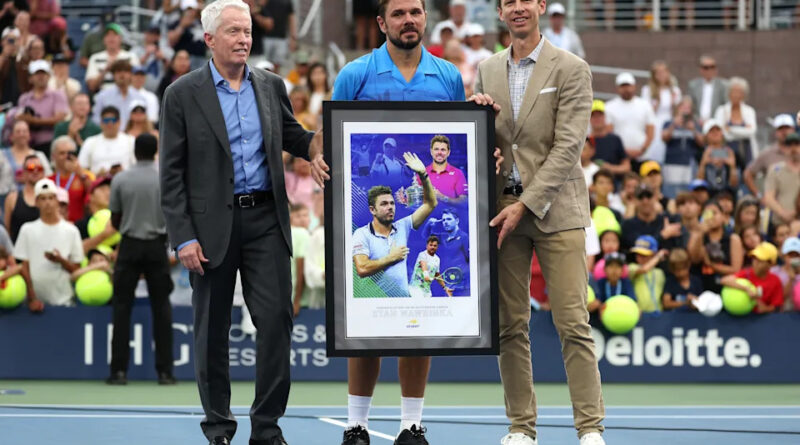
Thanks to Kypson, the USTA had the chance Monday to correct its mistake. After the match, it was a nice touch for tournament director Eric Butorac to present Wawrinka with a framed picture including images of his three career-defining titles.

USTA CEO Craig Tiley (left) and US Open Tournament Director Eric Butorac (right), present Stan Wawrinka with a poster after his loss at the US Open on Monday in New York.
(Caleb Bowlin via Getty Images)
It belongs in a museum. Because while Federer, Nadal and Djokovic authored the history of tennis in this era, the other side of that coin was how emotionally and mentally frail most of their challengers turned out to be.
Advertisement
Among players born in the 1990s, only three won Slams: Daniil Medvedev, Dominic Thiem and Alexander Zverev, who each have one. A couple generations passed through the sport and none of them really had what it took in a big semifinal or final to unseat the legends.
Wawrinka wasn’t afflicted by that same problem. This is a guy who won 16 ATP titles — a good number, for sure, but a bunch of players who never sniffed majors won more. But when it really mattered, he looked Djokovic and Nadal in the eye, raised his level to the highest it could possibly go and beat them on the biggest stages.
That matters now and it will matter 100 years from now when people look back on the sport’s most important records.
It’s also not what Wawrinka thinks about when he assesses his place in the history of the game.
Advertisement
“I never try to do things for people to remember me in a way,” he said. “The only thing I can see this year, when I announced it’s my last year, is the love I receive in every single match I played and every tournament I play. So I feel super grateful with that.
“It’s also showing me that maybe I did the right thing all those 20 years by always try to give, always try to fight, always showing up, always trying to do my best, always trying to push my own limits in the sport. This is what, for me, was the most important, is what I get from the fans when I play.”
Thankfully, he got it one more time in New York, where a special career was honored with the special goodbye it deserved.