
SUSS GOOD Incubator supports student startups in gerontology
SINGAPORE – The Singapore University of Social Sciences (SUSS) has launched an initiative to support student-driven start-ups and social ventures that are developing solutions to social and environmental challenges.
The initiative has a focus on innovation for the needs of the elderly, in light of the Republic’s rising aged population.
Called the GOOD Incubator, the platform provides structured support to help start-ups develop, test and scale their innovations. This includes a programme SUSS is co-developing for social enterprises to test-bed their solutions in partnership with social service agencies.
The incubator initiative was introduced at the university’s fourth Geronpreneurship Innovation Festival (GIF), which was held on Aug 26 at the Suntec Singapore Convention and Exhibition Centre.
In his keynote address at the event, Minister for Health and Coordinating Minister for Social Policies Ong Ye Kung said ideas and prototypes have to be more practical, and in tune with real-life challenges.
He highlighted two such innovations that were presented at the festival: the AI-powered WhatsApp Companion for the elderly, and Sentinan, an AI-enabled tool for earlier detection of heart risks, particularly among seniors in the community.
WhatsApp Companion is an AI-powered smart messaging system designed to engage less active seniors and encourage them to join community activities. It is developed by digital health start-up Marymount Labs, in partnership with the charity Tzu-Chi Foundation.
Speaking to the media at the festival, co-founder of Marymount Lab Zacchaeus Chok, 25, said the project started as a bridge “to close the gap between doctors and patients in between visits”.
“That was when we realised there was a challenge faced by the active ageing centres (AACs) to encourage more seniors living in the area to take part in their activities. We used our WhatsApp Companion to engage them – providing them with pleasantries like greetings in the morning, personalised health check-ins, activity recommendations, and gentle nudges,” he said.
Marymount Lab started working with two AACs under Tzu-Chi Foundation and has engaged about 700 seniors so far. Since the foundation started using the WhatsApp Companion, it has seen a 50 per cent increase in participation rates for its AAC programmes.
![CMG20260826-Darwis01 陈渊庄/ 杨樣 / Geronpreneurship Innovation Festival & Pitch for Good 2026 [Suntec 404] ***** Dr Ho Chin Keong (left) and Chok Yong Hsin, Zacchaeus (right) winners of Pitch for Good 2025, a regional startup competition](https://cassette.sphdigital.com.sg/image/straitstimes/02d627bbd62405fdea78a296105457c26986eb88fdef88367174fed11b58ac7d?w=480)
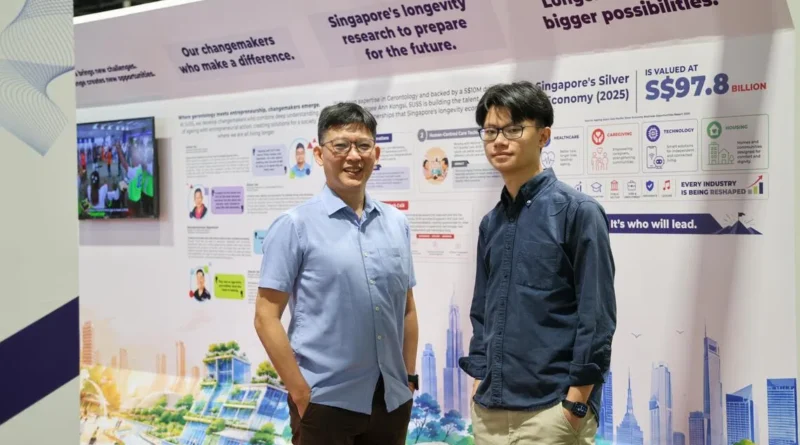
Co-founder of Sentinan, Ho Chin Keong (left), and co-founder of Marymount Lab, Zacchaeus Chok. Their companies won Pitch for Good 2025, a regional start-up competition.
PHOTO: LIANHE ZAOBAO
Sentinan, the other project Ong mentioned, is a digital stethoscope designed to capture, record, replay heartbeat, and review the recording across hardware, companion apps, and the web portal.
It is being developed to use AI to support earlier detection of heart risks, particularly among seniors above the age of 65 years.
“These seniors have hidden heart issues such as atrial fibrillation, which is an irregular and often very rapid heart rhythm. If (it is) not treated, the elderly will face a higher risk of stroke and heart failure,” said Sentinan co-founder Ho Chin Keong, a former technology lead at A*STAR.
“We are working in phases with the help of a doctor to listen and ‘read’ the recording. We have also worked with the AACs under Lions Befrienders and have screened about 300 seniors.”
GOOD Incubator is supported by the Ministry of Education (MOE), through its Innovation & Enterprise Office Decentralised Funding, which comes under Singapore’s broader Research, Innovation and Enterprise 2030 (RIE2030) Plan.
Led by the National Research Foundation (NRF) under the Prime Minister’s Office, the plan seeks to strengthen Singapore’s research and innovation ecosystem and address key economic and national priorities.
One of RIE2030’s first Grand Challenges, “Maximising Healthy and Successful Longevity”, focuses on addressing critical challenges associated with an ageing population through healthcare, socio-environmental, AI and technological innovations.
SUSS president Tan Tai Yong said promising ideas have emerged over the years from students, researchers, and community partners, but “expertise alone does not create impact”.
“We have also learnt that turning those ideas into real-world impact requires an ecosystem that brings together technology, enterprise, philanthropy, and community organisations… The launch of the GOOD Incubator marks the next chapter of that journey,” he said.