
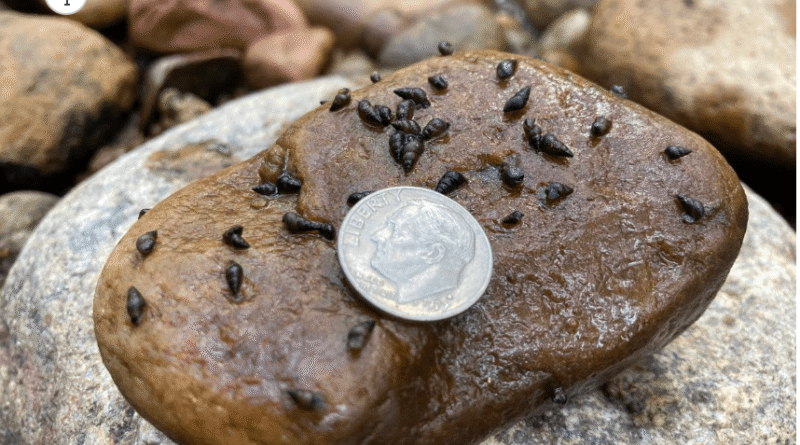
New Zealand mudsnails spread to Carter Lake
New Zealand’s worst export, the voracious and self-cloning mudsnail, have invaded Carter Lake reservoir for the first time, Colorado Parks and Wildlife officials announced Monday, part of a dangerous invasion that has fast-crawled its way up the Front Range.
The female New Zealand mudsnail can clone itself, meaning just one gastropod in a pair of waders or boat bilge can launch an infestation and quickly result in hundreds of thousands of snails per square meter. The snails survive a bird’s digestion so can be spread far and wide, and they have no nutritional value and can thus starve fish carefully stocked by local wildlife managers.
The mudsnails eat up all the algae and aquatic life otherwise consumed by important insects, depriving other species of food. Their dense multiplication also clogs up reservoir inlets and outlets as well as recreational structures.
“To limit potential further spread, watercraft that have boated on Carter Lake should expect thorough inspections and, in some cases, decontamination when arriving at other bodies of water,” CPW said in a release. Warning and advice signs will be placed at Carter Lake, which is west of Berthoud in Larimer County.
“Boaters and swimmers can limit the spread of aquatic nuisance species by thoroughly cleaning, draining and drying all gear before using it in another body of water,” the agency said.
The mudsnails, which have clogged lakes from Ontario to Zurich, were first found in the Boulder area watershed in 2004, according to an interagency task force. Longmont found them in St. Vrain Creek, between Longmont and Lyons, in 2022.
The mudsnails are not to be confused with another fast-spreading Colorado invasive nuisance, the zebra mussel. The zebra mussel is regularly being detected in new spots up and down the Colorado River basin. We can blame southwestern Russia for that menace.