
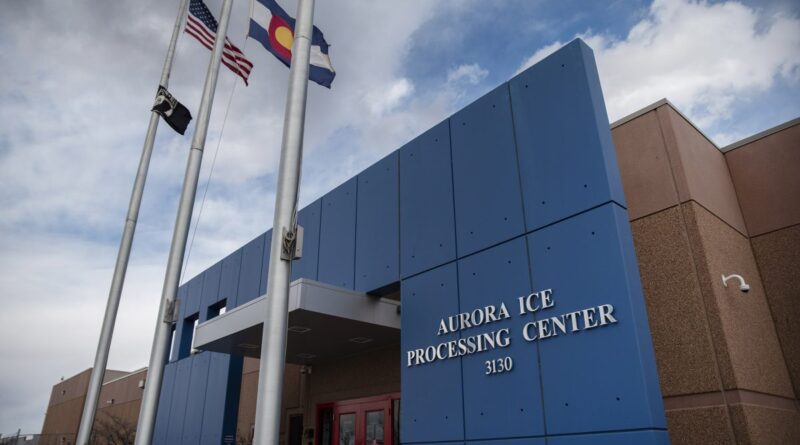
Judge blocks Colorado law on immigrant detention center inspections
A federal judge in Denver on Thursday temporarily blocked a portion of a new state law that expanded Colorado’s public health authority over the immigrant detention center in Aurora.
The ruling is a brief victory for the GEO Group in its showdown with state and local authorities over inspections intended to protect the health of those inside and outside of the facility.
But the ruling doesn’t appear to settle the state’s ongoing fight with GEO over the investigation of a tuberculosis infection at the facility. That’s because Colorado cited authority under pre-existing public health laws — and not the new law — when it sued GEO in state court earlier this week for failing to comply with a public health order. Thursday’s ruling in federal court does not affect those laws.
GEO, a for-profit company based in Florida, contracts with U.S. Immigration and Customs Enforcement to operate the facility, which is currently the only immigrant detention center in the state. That solo status was key in the decision.
In making his ruling, Daniel D. Domenico, the chief U.S. District Court judge in Denver, found that the GEO Group had sufficiently shown the law interferes with federal authority by singling out the detention center for special regulation.
“That is sufficient to establish that (the law) discriminates against GEO based on its status as a federal contractor,” Domenico wrote.
The Colorado legislature passed the law at issue this year. It clarifies and expands state and local public health authority over facilities that detain immigrants for civil immigration proceedings, including any “facility that is operated on behalf of or pursuant to a contract with federal immigration authorities.”
The law specifies that it does not apply to facilities run directly by the federal government, which Domenico also noted.
“The bill (and defendants) acknowledge that they could not constitutionally regulate a federally operated facility in this manner,” he wrote, referring to the Colorado officials named as defendants in the lawsuit.
Domenico’s ruling focuses on a portion of the law that requires state health authorities to conduct unannounced inspections at the facility at least once every three months and another portion that imposes a new $50,000 fine for failing to comply. It does not block portions of the law that clarify existing authority or that have not yet gone into effect.

In what could be a win for the state in its ongoing fight with GEO over a tuberculosis investigation, the ruling also doesn’t affect pre-existing state public health laws governing inspections at the facility. Instead, Domenico notes several times that GEO did not contest those laws.
“GEO has conceded, for purposes of this case, that it is subject to the panoply of generally applicable laws and regulations that do not directly target this federal activity,” Domenico wrote.
In addition, Domenico agreed with an argument by the state’s attorneys that GEO’s contract with the federal government requires it to abide by state law.
“There are several contractual provisions to that effect,” he wrote. This includes one provision requiring GEO to “accept and provide for the secure custody, care and safekeeping of detainees in accordance with the state and local laws.”
In a statement, Colorado Attorney General Phil Weiser practically celebrated.
“Today’s ruling granted the GEO Group a narrow, temporary injunction against one provision of a new 2026 law — not the broad relief it sought — and leaves Colorado’s existing public health and safety authority intact,” Weiser said.
The injunction is in place only until October 15, when GEO’s contract with the federal government expires.
“The provisions of any new contract that GEO (or another operator) obtains from the federal government may alter the analysis significantly, or make proceeding further with this case unnecessary at all,” Domenico wrote.