
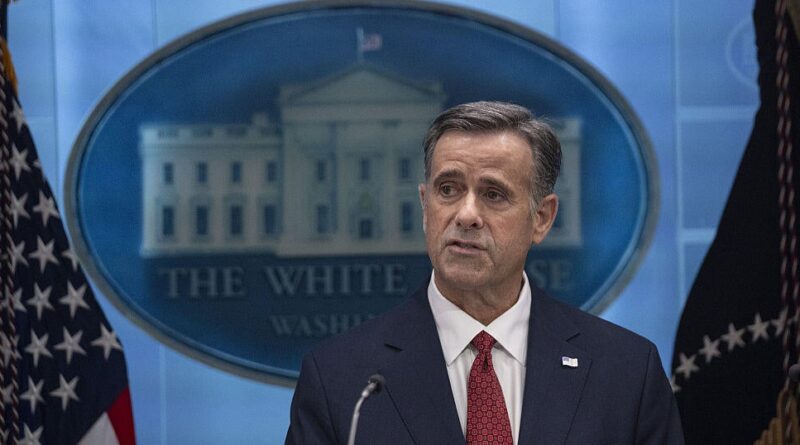
CIA Director John Ratcliffe, during secretive trip, warned Russia not to attack NATO
The purpose of CIA Director John Ratcliffe’s visit to Moscow this week was to warn Russia not to attack NATO member states, according to multiple people familiar with the matter, amid U.S. intelligence assessments that Russia could try to test NATO.
Ratcliffe also brought up Iran, warning of additional sanctions if the Strait of Hormuz does not reopen to shipping traffic, the people familiar with the matter told CBS News.
The secretive visit to the Russian capital came to light on Tuesday, after a U.S. Air Force jet was spotted flying into a Moscow airport and a diplomatic motorcade moved through the city. CBS News was first to report the trip, which is Ratcliffe’s first known visit to Russia as CIA director. Ukraine was told that a U.S. delegation would travel to Moscow and was asked to hold off on strikes for the duration of the visit, according to a senior Ukrainian official.
The Wall Street Journal was first to report on Ratcliffe’s warning not to attack NATO.
The CIA declined to comment on the reasons for Ratcliffe’s trip.
President Trump confirmed the visit to Moscow in an interview with radio host Glenn Beck earlier Wednesday, but said it wasn’t related to Iran or to Russian desires to test NATO, describing it as a “semi-routine” trip. Mr. Trump said “something may come out of” Ratcliffe’s visit, pointing to his push to end Russia’s war with Ukraine.
Kremlin spokesperson Dmitry Peskov told reporters in Moscow that Ratcliffe spoke with Russian intelligence officials but didn’t meet with President Vladimir Putin.
On Thursday, Peskov dismissed media reports about the purpose of Radcliffe’s trip, French news agency AFP reports.
“A lot of such scare stories are being published right now. Of course, they have nothing to do with reality,” Peskov said, adding that Russia “is facing a very aggressive policy towards itself from European countries.”
Recent American intelligence assessments have indicated that Putin could be willing to authorize provocative actions on NATO territory, including cyberattacks, hybrid actions and other operations that fall short of conventional military action, CBS News reported earlier this month. The likely goal would not necessarily be to trigger a war, but instead to test NATO’s unity and the Trump administration’s willingness to defend NATO allies, according to U.S. officials.
A pattern of recent Russian actions has prompted concerns, the officials said, including drone incursions into Romania, a Russian missile that crossed into Poland last month and an uptick in alleged sabotage actions and cyberattacks in Europe.
Under Article 5 of the treaty that created NATO, members of the alliance are expected to come to each other’s defense if attacked, a provision that the U.S. invoked after the Sept. 11, 2001, terror attacks. But Mr. Trump has long questioned NATO’s reliability and criticized member states for — in his view — not contributing enough to their own defense.
Mr. Trump has also publicly pushed Russia and Ukraine to end their four-year-long war, though diplomatic efforts have appeared to stall.
Meanwhile, Russia has maintained its partnership with Iran during the U.S.’s war with the Middle Eastern state, providing intelligence to Iran on U.S. positions in the region, CBS News reported earlier this year. The two countries have also cooperated on drone manufacturing for years.