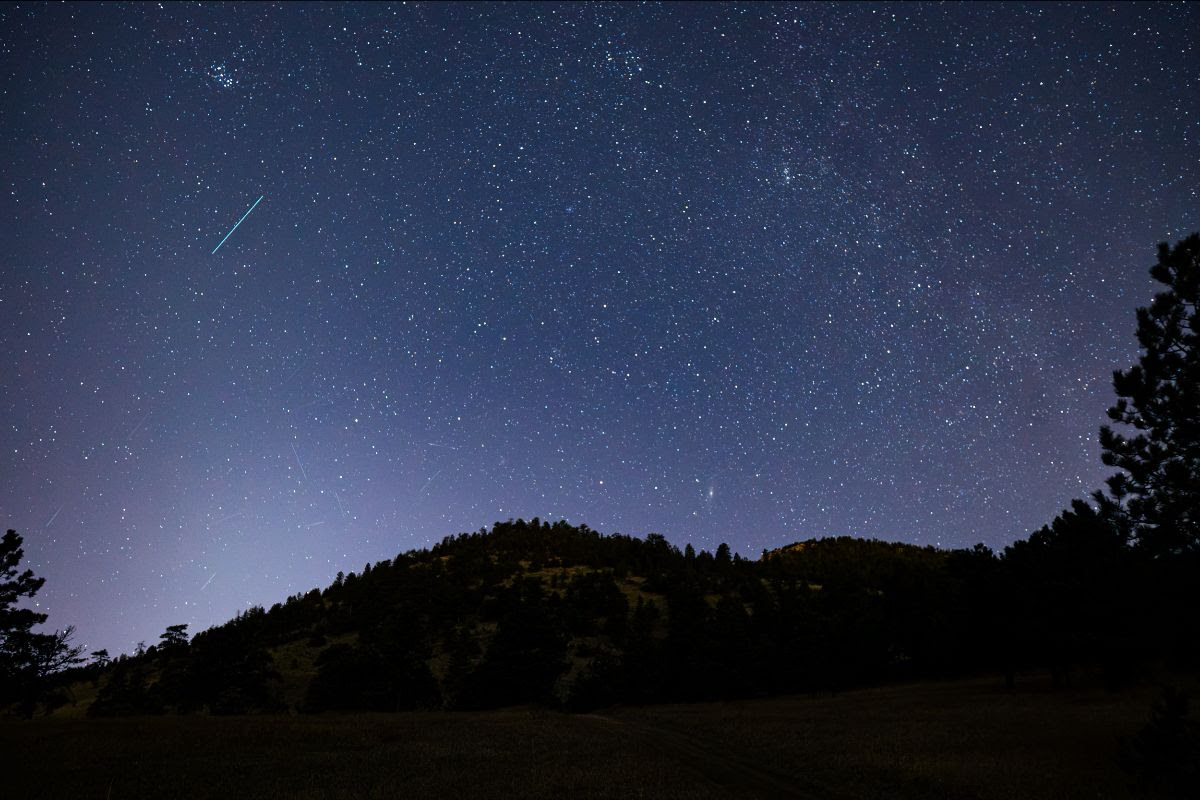
This state park is Colorado’s first Urban Night Sky Place. Here is what it means.
▶ More below: Where to take advantage of the darkest skies in Colorado
Carolyn Collins Peterson takes a special joy from sitting on her deck at night and seeing the Milky Way. It reminds her of her childhood.
She grew up in Boulder, and back in her day, the stars twinkled throughout the night sky. They influenced her decision to research comets in grad school, and they’re why she not only wrote for Sky and Telescope magazine but created shows on astronomy for planetariums and museums with her husband.
Now those stars, or at least their twinkle, are typically snuffed out by light pollution, unless they have the megawatt power of Venus. Even where she lives, in Gilpin County, the glare of artificial light took a good chunk of fun out of the night sky years ago.
But the stars are twinkling again for those who visit nearby Golden Gate Canyon State Park. The state park in Gilpin County was certified in September by DarkSky International as an Urban Night Sky Place. Golden Gate is the first place anywhere in Colorado to receive that specific distinction. It’s the second state park to receive certification from DarkSky.
The first, Jackson Lake State Park, earned DarkSky Park designation in 2020. That’s a higher distinction, and the standards are stricter. Jackson’s skies are darker, but it is located next to Orchard, a tiny town with a tiny number of porch lights compared with the metro area.
Golden Gate’s proximity to Denver makes it a good fit for the Urban Night Sky designation, which honors places that do what they can despite the handicap of being next to major cities and the inevitable glare they emit.
Peterson is a DarkSky ambassador, someone who advocates for the night sky by spreading the word about light pollution and encouraging easy fixes such as directing porch lights downward and turning them off late at night.
She worked with Gilpin County to reduce light pollution. It now has a light ordinance governing outdoor lighting, including preventing “light trespass,” or random rays spilling onto other properties, and requires shields over outdoor lights in addition to warmer light temperatures (harsh blue light is a major polluter) and permits for commercial spaces.
Peterson wrote a letter to DarkSky supporting Golden Gate’s designation and remains impressed by the park’s efforts to take back what’s left of the night sky.
“There are some areas where they have to have a little bit of lighting,” Peterson said of Golden Gate. “But they’ve done quite a bit to mitigate it. It’s better than it used to be.”
You can make out the Milky Way at night, especially from Panorama Point, which overlooks the part of the park that blocks a lot of the light from Denver, and from her home, a mile from the park boundary. This makes Peterson happy.
“The night sky belongs to everyone,” she said. “We should all be able to see it.”
The stars come out at night
It’s safe to say most of Jackson Lake’s patrons hadn’t heard of a dark sky certification when the state park received it in 2020. Isn’t the night sky already dark?
Sure, but as both Jackson and Golden Gate discovered, it takes quite a bit of work to make the cut.
Jackson Lake had to make several changes, such as directing light fixtures downward, installing light sensors in bathrooms and filling out a 37-page application that required getting in touch with Orchard and Morgan County administrators and residents and gathering letters of support. Jackson needed buy-in from those residents, who even made changes to their own lighting. It typically takes several years to complete an application and get approval. Even with the reduced standards of an urban sky designation, Golden Gate took two years to complete the process.
At first, dimming the lights at Jackson confused visitors, who were there to party and go boating, not look at the sky, and associated night lights with comfort and security. Some flat out admitted they were afraid of the dark. But public perception has shifted.
“Today, negative feedback is rare,” said Erika Wiedemann, administrative assistant for Jackson Lake State Park. “At first, visitors can express surprise at the darkness, but these moments frequently turn into rewarding conversations about light pollution, astronomy and wildlife preservation. More often, the darkness is met with enthusiasm.”
Golden Gate is a big place, with a lot of buildings and, consequently, lots of lights. Bronwyn Phillips, the park’s administrative assistant, developed a plan to carry out the park’s dark sky application, which included a Google spreadsheet on the progress of checking on the 120 light fixtures in the park. She updated nearly half of them. She also helped beef up the astronomy programs offered at Golden Gate.
“In 2023, when we started thinking about this, we had one astronomy program,” Phillips said. “By the end of this year, we will have a couple dozen.”
As a part of the certification, both parks had to develop and present dark sky programming. But these are meant to be fun opportunities, not just lectures: The staff at both parks even call them parties. Once a month, Jackson and Golden Gate host “star parties” with members of local astronomy clubs who bring expensive, elaborate telescopes for visitors to look through.
As a result, Jackson, in recent years, has built up a crowd outside of boating season. People seek out Jackson just because it’s a dark sky place and go strictly for stargazing, Wiedemann said. In fact, it’s popular enough now that one of the main causes of conflicts between campers comes when the partiers are spraying their light into the path of those who wish to stargaze.
“The park has attracted a whole new demographic,” Wiedemann said. “Stargazing now provides consistent recreational opportunities even at a quieter time of year. It’s changing into one of the main draws of the park.”
Soothing stars
Dark skies serve more a purpose than offering pretty stars to look at. They’re good for us.
We rest better when the night sky isn’t full of artificial light throwing our circadian rhythms out of whack. Other wildlife, such as migrating birds, prefer it as well. Quieting lights keeps some of the annoying critters away, such as moths and other flying insects. There used to be piles of them every morning by the bathrooms at Jackson Lake. Now they’re gone.
Jackson Lake State Park was also chosen as a pilot project location for a bat survey completed in 2023. Scientists picked the park because of those dark skies, which could set an example for other parks to help boost the bat population.
“Starting with the DarkSky certification in 2020 and looking at the projects being done,” Wiedemann said, “it is easy to say that the certification has reached across every aspect of the park and reshaped its ecology in a positive way.”
Dark skies fit with a state park’s mission, Phillips said, of protecting Colorado’s environment.
“Stargazing is a natural resource,” she said. “That’s our whole agency’s prerogative is to protect natural resources.”
Seeking out the stars
Places such as Dinosaur National Monument and the Great Sand Dunes, Black Canyon of the Gunnison and Mesa Verde national parks already carry DarkSky designations. Nine communities, including as Breckenridge, Lake City, Ridgway and Westcliffe, do as well.
Colorado may one day have the most dark sky places in the world: In addition to what’s already out there, more than 30, including 12 state parks, have started the process to certification. Many of these places, like Jackson Lake, have discovered that dark skies can be a beacon or tourists.
This is, in part, because of the Colorado Tourism Office’s Dark Sky Certification Program, which provides destinations and state parks with resources and expertise to help them get their own designations. In June, the office launched the Colorado Stargazing Trail, a guide to experiencing the night sky at certified locations through stargazing events and experiences. Golden Gate used the tourism office as a resource during its certification process.
Focusing on dark skies grew out of the tourism office’s strategic plan to enhance tourism across the state.
“Colorado continues to lead the way in sustainable and responsible tourism,” Hilary Lewkowitz, the Colorado Tourism Office destination development director, said in a statement. “Preserving access to the stars enriches the visitor experience, strengthens local tourism economies, reduces energy consumption, and enhances quality of life in communities statewide.”
Golden Gate already is drawing interest from stargazers asking about programs. The park is already known for its leaf peeping, camping and good view from Panorama Point. Now it wants to be known for the Milky Way as well.
“I’m a big astronomy nerd, so this gives people opportunities to come and experience our parks in a different way,” Phillips said. “This is something else we can be proud of.”
Do look up
This November is an extraordinary month to take advantage of the darkest skies in Colorado.
- Nov. 12: The Northern Taurids peak. These are meteors showers, producing around five meteors per hour under ideal conditions, that appear to originate from the northern part of the Taurus constellation. NASA says the showers occasionally throw out a bright fireball.
- Nov. 15-16: Get outside around 5 a.m. and look southeast. If the sky is clear, Mars and Jupiter will appear to nearly touch. Jupiter is the very bright point. Mars is reddish. Venus may be visible closer to the horizon.
- Nov. 17: You won’t be able to see it, but if you look toward the western horizon and pick out the constellation Ophiuchus (the Serpent Bearer) you can imagine where NASA’s Voyager 1 is as it becomes the first human-made object to travel a light-day from Earth. NASA explains “this means a signal traveling at the speed of light takes 24 hours to reach the spacecraft —and another 24 hours for us to hear back from it!
- Nov. 17-18: After the moon sets, but before dawn, you may be able to see around 15 meteors per hour during the peak of the Leonids meteor shower. The annual Leonids, related to the comet Tempel-Tuttle, are usually bright and sometimes colorful. They’ll be visible through Nov. 30, NASA says.
- Nov. 24: Look east around sunset to watch the first in a series of three consecutive supermoons rise. The moon’s orbit is kind of oval, so when it is nearest the Earth it looks huge. As it rises, it may look even larger on the horizon. NASA says this is called the Moon illusion and it is a common effect no matter where the Moon is in its orbit.