
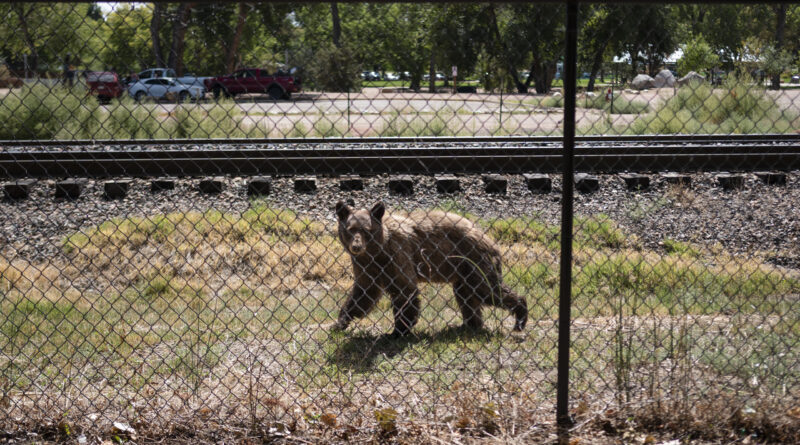
Colorado killing of bears soars to 3 times last year
Nearly 300 black bears have been euthanized by Colorado Parks and Wildlife this year in a startling response to a record number of human-bear contacts driven by wildfire and drought.
Wildlife officers put down 294 bears by Aug. 31, compared with 83 euthanized through August last year, the state announced Friday. The agency said it was reporting bear numbers ahead of the normal annual report because “the public has expressed strong interest” in the fate of the state’s hungry bears.
Black bears need 20,000 calories a day this time of year to prepare for hibernation, and drought and wildfire have stolen much of their normal food, typically berries and acorns. They increasingly forage where humans have food or have left behind scraps and trash, often startling and sometimes attacking hikers or homeowners.
What the state calls a “drastic increase” in conflicts has seen 8,672 reports of sightings and incidents, after 3,680 reported through August of last year. This year, 98 bears have been relocated, compared with 33 at this time last year, in addition to the spike in euthanization.
“Relocation and euthanization options are exercised for bears that have been hit by motor vehicles, are found suffering from poor health and body condition, have attacked humans, or have entered homes or other structures,” a Colorado Parks and Wildlife statement said.
The numbers are well above the average over the past five years, the state said, the number of escalated state responses is proportional to the rise in overall human-bear incidents. “The number of reported incidents in 2026 to date is 3.6 times” the past five years, the state said.
That has led to relocations being 3.5 times the average, and euthanizations carried out at 2.7 times the five-year average.
The Colorado Sun previously reported that in Pitkin County, CPW recorded 331 bear reports, up nearly 31% from 252 last year. More tellingly, incidents involving property damage and bears accessing food and nonfood sources were up 56%, according to CPW.
The increase in conflicts includes incidents like an August encounter near the two forks confluence of the South Platte River, when a female bear knocked over an angler and bit his legs. The attack, which sent the man in his 60s to a hospital with injuries, was witnessed by a number of others on the trail. The man was not carrying any fish, the state said. That bear was tracked in Jefferson County by a dog team and euthanized the next day.
Colorado officials continue to use the increasing numbers to amplify warnings about how to behave around bears:
- Stay alert and stay together — Pay attention to surroundings and stay together. Walk, hike, jog or cycle with others when possible. Keep kids within sight and close by. Leave earbuds at home and make noise periodically so bears can avoid you.
- Leave no trash or food scraps — Double bag food when hiking and pack out all food and trash. Don’t burn food scraps or trash in your fire ring or grill. Leaving scraps, wrappers or even “harmless” items like apple cores teaches bears to associate trails and campsites with food.
- Keep dogs leashed — Letting dogs chase or bark at bears is asking for trouble; don’t force a bear to defend itself. Keep your dogs leashed at all times or leave them at home.
- Camp safely — Set up camp away from dense cover and natural food sources. Cook as far from your tent as possible. Do not store food, trash, clothes worn when cooking or toiletries in your tent. Store in approved bear-resistant containers or out of sight in locked vehicles or suspended at least 10 feet above the ground and 10 feet from any part of the tree. Local regulations vary.
- Know what to do if you see a black bear — If you see a bear before it notices you, don’t approach. Stand still, enjoy, then quietly move away. If a bear sees you, back away slowly. Never run; running may trigger a chase response. If a bear approaches, hold your ground, wave your arms and yell “Hey bear” until it leaves. If it keeps approaching, use bear spray. If a black bear makes contact with you, do not play dead; fight back aggressively.
This is a developing story and may be updated.