
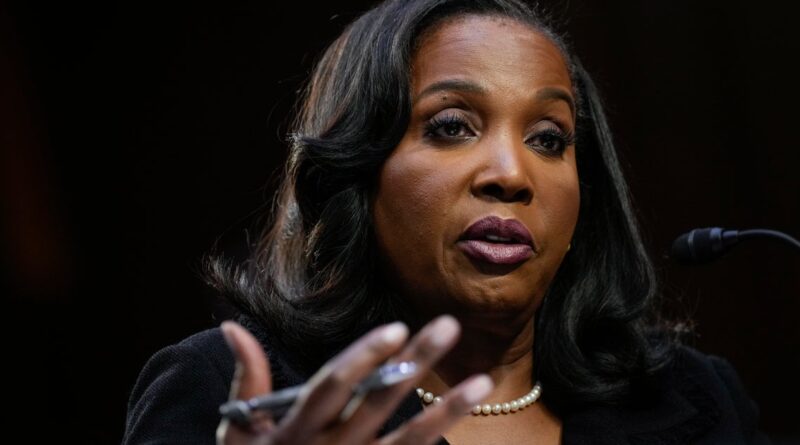
Fed’s Lisa Cook pushes back on Trump firing threat, says she “never committed mortgage fraud”
Washington — Federal Reserve Governor Lisa Cook defended herself against allegations from the Trump administration that she made misrepresentations on mortgage documents, arguing in a new letter that she has “never committed mortgage fraud.”
In the letter to the White House dated Wednesday, Abbe Lowell, Cook’s lawyer, said that attempting to fire Cook on the basis of accusations made by Bill Pulte, the head of the Federal Housing Finance Agency, would “ignore the facts and the law.” Lowell told White House counsel David Warrington that the claims against Cook are “unfounded and untrue.”
“Governor Cook has never committed mortgage fraud or any intentional wrongdoing, and there is no legally cognizable cause for removing her from the Federal Reserve Board,” he wrote.
Mr. Trump first tried to remove Cook from her post on the Fed’s Board of Governors last year after Pulte claimed she falsified mortgage documents related to two properties, one in Ann Arbor, Michigan, and the other in Atlanta. Both properties were purchased before Cook was confirmed as a Fed governor during the Biden administration.
Cook filed a lawsuit challenging her removal as a violation of federal law, which allows the president to remove Fed governors only “for cause.” In June, the Supreme Court allowed Cook to continue serving in her role as her case proceeds in the lower courts. The high court said in its 5-4 decision that Cook was entitled to notice and the opportunity to respond to the allegations before she was terminated, which she did not receive.
Weeks after the Supreme Court handed down its decision, Mr. Trump mounted a new effort to oust Cook. The White House informed her in an Aug. 5 letter that the president was considering firing her because of the mortgage-fraud allegations and laid out the accusations against her. It set an Aug. 26 deadline for Cook to respond to the claims made by Pulte.
In the letter, White House deputy chief of staff Dan Scavino said that Cook signed a mortgage agreement classifying the Atlanta condominium as her “primary” residence, even though she signed a mortgage document that classified her home in Ann Arbor the same way. The White House also claimed that Cook listed the Atlanta property for rent roughly 14 months after signing the mortgage, even though she never disclosed rental income in financial disclosures for 2022 and 2023.
“There is a distinct nexus between a basic level of trustworthiness and care in financial matters and the duties of a Member of the Board of Governors,” Scavino wrote. “Because the allegations in the Criminal Referral reflect on your honesty, trustworthiness, and competence to perform the duties of the office you currently hold, the President has determined that there is reason to believe they constitute cause to remove you from your position on the Board of Governors of the Federal Reserve.”
Cook’s response
But Lowell said Cook’s signing of a “primary” mortgage agreement, which was provided to her by her lender, was “an entirely inadvertent oversight.” Cook also “regularly” indicated in submissions that her “primary” residence was in Michigan, and confirmed to her lender that the Atlanta property was a “2nd home,” he said. Lowell argued that it was within the lender’s discretion to classify the Atlanta mortgage as “primary” or “secondary.”
“Governor Cook’s apparent mistake on a form provided to her by her lender, which was aware of her other residences, was unintentional, not criminal, and occurred in her private capacity before she took office,” Lowell wrote.
He also noted that neither the White House’s letter nor Pulte stated that Cook received a preferential interest rate on any property.
Regarding the White House’s allegations that Cook failed to disclose rental income from her Atlanta property, Lowell told Warrington that while Cook briefly listed the condo for rent, she decided not to rent it.
Lowell went on to accuse Mr. Trump and members of his Cabinet, including Treasury Secretary Scott Bessent and Attorney General Todd Blanche, of listing two properties as “primary” residences on their own mortgage filings.
“The President clearly recognizes that making such a mistake does not render a person — not himself nor the five members of his cabinet — unfit for office,” he wrote. “Attempting to remove Governor Cook on the basis of these allegations of preoffice conduct would be ‘corrosive of the independence that Congress sought to preserve,’ … and would fall woefully short of the standard that the Supreme Court has set. And doing so selectively would raise troubling questions about why President Trump is singling out Governor Cook.”
In a separate statement, Lowell and Norm Eisen, another lawyer for Cook, said they are prepared to go back to court to challenge “any illegal attempt” to fire Cook.
Critics of the president have accused him of attempting to oust Cook in an effort to assert more control over the central bank and warned that his actions threatened the independence of the Fed. Mr. Trump also repeatedly attacked its former chairman, Jerome Powell, for failing to lower interest rates quickly enough.
Federal prosecutors in Washington, D.C., issued subpoenas to the Fed earlier this year as part of a criminal investigation into Powell related to the years-long project to renovate the central bank’s Washington, D.C., headquarters. But prosecutors ended the criminal probe after it became an obstacle to confirming Powell’s successor, Kevin Warsh.
Warsh, whom Mr. Trump selected to lead the Fed, took over as the new chair of its board in May.