
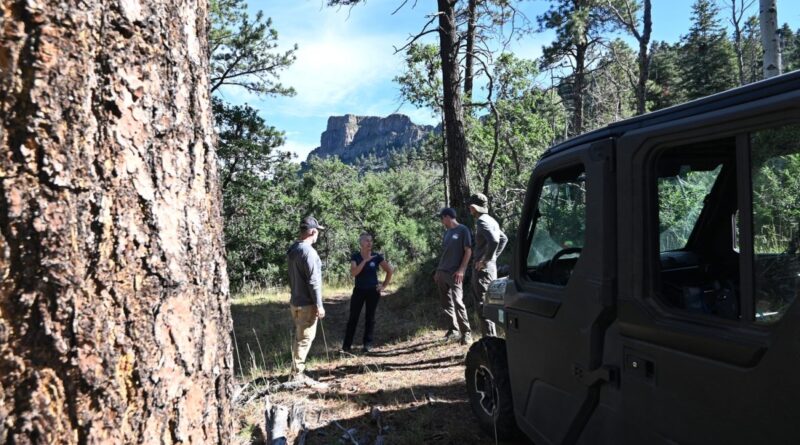
New Trails at Fishers Peak State Park add to revival in Trinidad
For generations, Fishers Peak was something people in Trinidad could see but not visit.
The 9,633-foot mesa rises above the city like a landmark on a postcard, its flat-topped silhouette visible from Interstate 25 as travelers cross into Colorado from New Mexico. But the 19,200 acres surrounding the peak were private ranchland until the state, city and conservation groups came together to protect the property and open it to the public.
Now, five years after Fishers Peak became Colorado’s 42nd state park, there are nine more miles of trails to explore.
Colorado Parks and Wildlife opened three new trails Aug. 14 — Storyteller, First Spring and Chaquaqua — adding loop options that connect with Fishers Peak Trail, the park’s primary route toward the summit.
The new trails give hikers and mountain bikers ways to return to the trailhead without retracing their route. They also provide alternatives during the park’s annual peregrine falcon closure, when access to the summit is restricted from March 15 through the end of July.
“These trails give people more ways to experience Fishers Peak throughout the year,” said Crystal Dreiling, the park manager. “We plan our trails with the visitor experience in mind, from the views and landscape to the stories people can discover along the way.”
The names themselves tell some of those stories. First Spring is named for a longtime landmark on the property. Chaquaqua, pronounced “cha-Kwak,” takes its name from the Chaquaqua Plateau visible from the trail. Storyteller encourages visitors to pay attention to the landscape, including lightning-scarred trees and evidence of past human use.
The trails climb through several of the park’s ecological zones, from grasslands and piñon-juniper to higher-elevation forests.
On Aug. 15, CPW also opened the 4.7-mile Goldenrod Trail to mountain bikes. The trail had previously been hiking-only; it is now open to both, although mountain bikers may only ride it uphill.
Fishers Peak became a state park in June 2020 after the state and conservation groups acquired the former Crazy French Ranch for about $25 million. The city of Trinidad had approached The Nature Conservancy and the Trust for Public Land in 2017 about helping protect the property, in part because local leaders saw recreation as a potential economic driver for a community that had weathered decades of boom-and-bust cycles.
In the 1880s and early 1900s, Trinidad was a bustling coal town and a stop along the Atchison, Topeka and Santa Fe Railway. In the 1970s, the city became known internationally for an unlikely claim to fame: Dr. Stanley Biber’s gender-affirming surgery practice earned the town the nickname “sex-change capital of the world.” Then, recreational marijuana brought a surge of visitors and tax revenue after Colorado legalized sales in 2012. However, the collapse of the local marijuana market when New Mexico legalized weed sales in 2021 triggered budget struggles for the border town.
As Trinidad searched for what might come next, state and city leaders, artists, entrepreneurs and outdoor advocates began pushing a new vision for the community. Artists and entrepreneurs invested in the historic downtown, while outdoor advocates saw potential in the region’s mountains, mesas and extensive network of dirt roads.
But the vision has not transformed Trinidad overnight. A 2024 Colorado Sun examination of more than $150 million in public and private investment found that the city’s economic reinvention remained a work in progress, with businesses opening and closing even as outdoor recreation, arts and tourism emerged as potential new pillars.
Fishers Peak was one of the biggest pieces of the recreation strategy.
During a 2019 community outreach process, more than 300 Trinidad residents, including about 100 schoolchildren, voiced support for hiking, biking, horseback riding, camping, fishing and hunting on the property. Conservation groups saw an opportunity to protect its wildlife habitat while opening the land to public recreation.
The park is still being developed in phases, and much of its 19,200 acres will remain undeveloped wildlife habitat. Five years after Fishers Peak became a state park, the vision is becoming increasingly tangible — more trails, more ways to explore the mountain and more reasons for people to come to Trinidad.

Tourism is in decline in Trinidad. Lodging tax revenue has fallen for two years and net taxable sales in the city have declined since reaching a high point in 2023. Sales taxes make up more than 44% of the city’s annual budget and have grown increasingly important as tax revenue from marijuana collapses. In 2020, the city spent more than $3.8 million collected on marijuana sales on dozens of projects while retaining a reserve of nearly $4.7 million. That marijuana-supported spending has dropped to around $500,000 a year with a reserve fund of less than $100,000 as legal weed in neighboring states like New Mexico slow demand in Colorado’s border towns.
Joe Kozlowicz and a friend opened Tarantula Cycles in downtown Trinidad in 2022 hoping to cater to mountain bikers and gravel riders flocking to Las Animas County and Fishers Peak State Park.
The new mountain biking singletrack at Fishers Peak — part of a larger plan to develop as much as 100 miles of bike trails in the park — is a great first step because now pedalers can do several loops and variations instead of simply heading up and down the same trail, Kozlowicz said. Plans for backcountry campsites in Fishers Peak State Park and the recent addition of a 2,220-acre ranch to New Mexico’s Sugarite Canyon State Park to the south creates a sprawling corridor of wildlands for overnight adventuring, Kozlowicz said.
With a steady stream of music in Trinidad and water recreation at Trinidad Lake State Park, the new bike trails are helping visitors build multiday vacations in the city, said Kozlowicz, whose bike shop is tracking toward its best year.
Kozlowicz is working with the Spanish Peaks Outdoor Coalition — one of 20 regional partnerships across the state — to build a master plan for long-term outdoor recreation across Huerfano and Las Animas counties.
“We have seen the boom-and-bust economy with coal and marijuana and when those go away you are left a bit stunned and shell-shocked,” he said. “There is no single silver bullet here but with the park, the lake and our downtown we are building a sort of guiding light based on outdoor recreation, culture, history and the arts. These new trails, they are a huge piece of the puzzle for us.”
Staff reporter Jason Blevins contributed to this story.