
Retaliation against U.S. should include non-tariff measures, Eby says


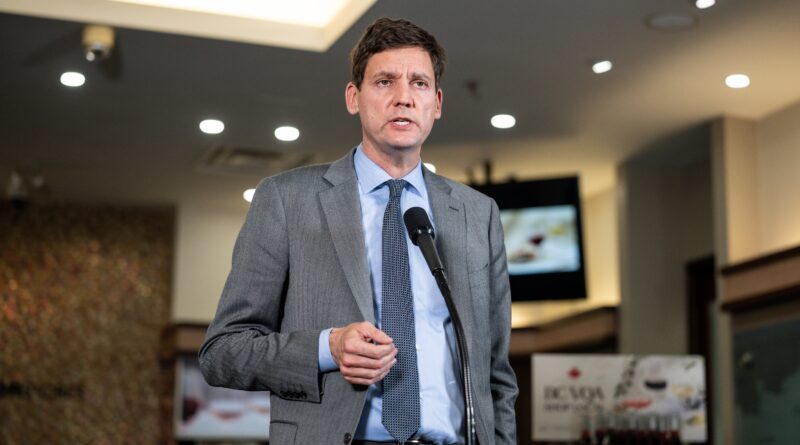
B.C. Premier David Eby said his province plans to soon provide a list of other levers it and the federal government can pull to hurt the Trump administration.ETHAN CAIRNS/The Canadian Press
B.C. Premier David Eby says he is pushing Prime Minister Mark Carney to embrace retaliatory trade war tactics other than tariffs, including walking away from the purchase of American fighter jets and hampering the shipping of Montana’s thermal coal through a port south of Vancouver.
Mr. Eby said at a press conference in Vancouver that Mr. Carney’s steps to stand up to the United States after talks broke down Friday have been proportionate and would afford Canadian businesses some protection.
The Premier also told reporters Tuesday that federal supports for workers affected by the latest round of punishing U.S. tariffs are a “good start.”
But he said Ottawa’s response is missing key elements, including revisiting the planned $12-billion purchase of F-35 fighter jets. He also suggested the government should review the exporting of thermal coal from the U.S. through the Westshore port in Delta, B.C., after which it is shipped to East Asia, where it is burned to generate electricity and industrial heating.
Mr. Eby said his province plans to soon provide a list of other levers it and the government of Canada can pull to hurt the administration of U.S. President Donald Trump.
“At this point, the ones that I feel comfortable talking about are both exclusively in the federal jurisdiction but have impacts on B.C.: the coal trains from the U.S. that go out through [Westshore], and the plan to spend $12-billion on a country that just kicked us in the back,“ Mr. Eby said, standing in a government liquor store, before shelves bereft of American alcohol.
U.S. tariffs push Canadian alcohol producers to rethink their biggest export market
Four takeaways from Canada’s tariff counterpunch
He said he has not talked to B.C. billionaire Jim Pattison, who owns nearly half the stock in the company that owns and operates the terminal that exports thermal coal from the Powder River Basin in Wyoming and Montana.
Last year, the Vancouver Fraser Port Authority reported the export of 14.8 million tonnes of thermal coal last year, which was a decline of roughly 14 per cent from the amounts shipped out in each of the previous two years. Meanwhile, the export of metallurgical coal, used for the production of steel and other products, increased nominally over that time span to 24.8 million tonnes, according to the port authority’s statistical report from earlier this year.
The federal government outlined Tuesday how it plans to retaliate against the new 50-per-cent tariffs Mr. Trump placed on around $28-billion worth of Canadian goods over the weekend after trade talks collapsed late Friday.
Ottawa is targeting nearly 900 different items, with most of the levies set at 25 per cent or 50 per cent, while a small number are subject to a lower 15-per-cent duty. The tariffs are scheduled to come into force on Sept. 8.
Energy academics say the proposal to tax this American coal or ban its export altogether could inflict pain on Canadian employees of the terminal and the railways that ship the black rock, which Ottawa has pledged to phase out of domestic energy production by 2030.
Campbell Clark: This whole trade war thing is stupid
But, they say, it could also irritate Mr. Trump as the thermal coal industry is an enthusiastic supporter of his political career and is located in a region where he has enjoyed popularity at the polls.
Kathryn Harrison, a political science professor at the University of British Columbia who focuses on climate and energy, said curtailing this coal would align with former prime minister Justin Trudeau’s 2021 campaign promise to phase out its export by the decade’s end. She observed that Canada is now a global leader in advocating for the end of the most carbon-intensive form of mass energy production.
Plus, Dr. Harrison noted, new export terminals for thermal coal have already been rejected by communities up and down the West Coast of the U.S., including in Bellingham, Wash.
“They’re trying to get this dirty stuff out while they still can and we have been facilitating that,” she said.
John Steen, director of the Bradshaw Research Institute for Minerals and Mining at UBC, said a tax or ban of these exports wouldn’t hurt Canadian allies South Korea and Japan because they could find more supply from Australia.
James Brander, a professor emeritus of UBC’s strategy and business economics division, said enacting such a policy would be a big escalation of the trade war, at a time when people within the American administration seem keen for an off-ramp that the Prime Minister also likely wants.
With a report from The Canadian Press