
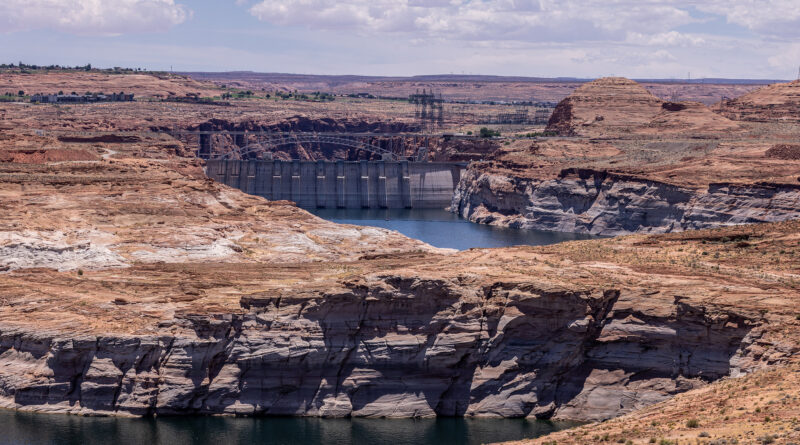
Nevada sues in federal court to block Colorado River cuts
Nevada became the first to sue over the Colorado River’s future Monday, citing frustrations over the steep, federally imposed water cuts it faces and the lack of mandatory cuts in upstream states, like Colorado.
The lawsuit came three days after the Department of the Interior released its final management plan for the river basin’s key reservoirs, Lakes Mead and Powell. States and tribes have heatedly debated how to manage the reservoirs after 2026, when the current management rules expire. The decision impacts 40 million people, economies and environments across the West.
States, like Arizona, have repeatedly threatened to sue while simultaneously calling it the “nuclear option” and a last resort. Now, Nevada says it is prepared to fight the proposed plan for as long as it takes.
“Southern Nevada could lose more than 70 percent of its already meager Colorado River allocation while the Upper Basin states of Colorado, Utah, New Mexico, and Wyoming are not required to contribute a drop,” Nevada Gov. Joe Lombardo said in a news release Monday. “This isn’t about political posturing; this is a matter of survival for a community that represents about two-thirds of our state’s citizens and the lion’s share of its economy.”
The Colorado River has been foundational to growth in the West, sustaining a multibillion-dollar agricultural industry and the rise of cities from Denver to Los Angeles. Tensions over the river’s future have reached new heights due to shrinking water supplies, persistent demands, rising temperatures and prolonged drought.
Even with tense disagreements, Colorado River officials have often said they do not want to turn to the courts. Water court battles are expensive and can last decades. Plus tying up water management in a legal process makes it harder to respond to each year’s changing water supply, experts say.
Under the Department of the Interior’s new management plan, Nevada could have its 300,000 acre-foot allocation of Colorado River water cut by up to 213,556 acre-feet in the basin’s driest years. (The state would cut back by less in years with more snow and rain to boost water supplies under the management plan.)
That would leave Las Vegas and surrounding cities with less than 86,500 acre-feet per year. In 2024, the area used nearly 212,500 acre-feet of water. One acre-foot roughly equals the annual water use of two to four households.
Federal officials didn’t analyze the impact of this level of curtailments on southern Nevada’s $180 billion economy, despite a legal requirement for the department to address those impacts, the state’s news release said.
It’s an “entirely unrealistic” level of shortages, said John Entsminger, the state’s top Colorado River negotiator and the Southern Nevada Water Authority’s general manager.
“Over the past 25 years, southern Nevada has become a global leader in water efficiency, reducing our Colorado River consumption by about 40 percent even as the community added 800,000-plus residents, so we have clearly demonstrated our ability to adapt and do more with less,” Entsminger said in the news release. “However, conservation has its limits, and there is just no way to meet even the basic needs of this community with the volume of water Interior has proposed.”
Nevada’s lawsuit, which includes the state, the Colorado River Commission of Nevada and Southern Nevada Water Authority, asks the federal court to set aside the new management plan and prevent it from being used until the conflict can be resolved.
The state pointed squarely at Colorado and its sister states in the Upper Basin in its complaint. Nevada officials said the upstream states have refused to agree to any tangible water cuts, instead relying on a “legally dubious” attempt to reinterpret century-old agreements to force downstream states to take all of the cuts.
Colorado’s negotiating team declined to comment on the litigation, saying they are still reviewing the filing from Nevada.
In the past, state officials have repeatedly stated that the upstream states have never used their full Colorado River allocation and they already take cuts in dry years.
The four states, combined, used about 4.3 million acre-feet on average each year between 2021 and 2025. The 1922 Colorado River Compact allocated 7.5 million acre-feet to the sub-basin.
In 2026, like previous dry years, farmers have not had enough water to finish the season, rafting companies have struggled with low flows, reservoirs are nearly empty, and communities are facing tough decisions over how to manage limited water supplies.
But some Coloradans agree with the Lower Basin. One environmental activism group, Save the Colorado, spoke in support of Nevada’s lawsuit Monday.
“Nevada has the lowest water use, and Las Vegas has the most aggressive water conservation programs,” Gary Wockner, Save the Colorado’s executive director, said.
If upstream states were as active as Las Vegas, new dams and diversions to help growing cities wouldn’t be needed, and the river system would be better protected.
“Penalizing Nevada and Las Vegas, while there’s not one consequential ‘cash for grass’ program in the entire Denver or Salt Lake City metropolitan areas, is nonsensical,” Wockner said.