
Higher BTO, resale flat demand expected after income ceiling raised, but supply can keep up: Analysts
SINGAPORE – The higher income ceiling will increase demand for public housing, but a strong pipeline of new and resale flats entering the market means supply will be able to keep pace, property analysts said.
They pointed to the steady supply of Build-To-Order (BTO) flats, as well as several waves of resale flats that will reach their minimum occupation period (MOP) in the coming years, after which they can be sold on the open market.
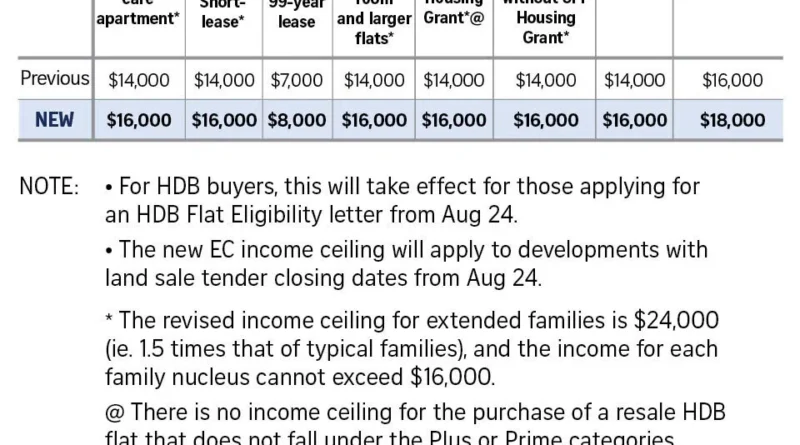
In his National Day Rally speech on Aug 23, Prime Minister Lawrence Wong said the income ceiling for BTO flats will be increased to $16,000 for families and $8,000 for singles. The current income ceiling is $14,000 and $7,000, respectively.
This higher ceiling will also apply to those buying an HDB resale flat with the CPF Housing Grant and Singles Grant.
While this is likely to drive up demand, analysts noted that many flats could enter the resale market in the coming years.
About 13,500 flats will reach their MOP in 2026. This will rise to 15,000 in 2027, and 19,500 in 2028.
HDB is also likely to exceed its target of launching 55,000 new flats from 2025 to 2027, National Development Minister Chee Hong Tat said in May.
In 2026, it will launch around 19,600 BTO flats, of which 4,000 are flats with shorter waiting times of fewer than three years.
One effect of the higher income ceiling is that buyers could be diverted away from larger, more expensive resale flats, said Christine Sun, chief researcher and strategist at property firm Realion (OrangeTee & ETC) Group.
Higher income buyers could have the budget to buy a larger or high-floor BTO flat, which would typically cost more, she said.
For instance, a first-timer family with a monthly household income of $16,000 would be eligible for up to $909,372 in bank loans, and can buy a flat priced up to $1.2 million, she noted.
She said many first-time buyers will likely prioritise BTO flats since their prices are substantially lower, and young couples may prefer a fresh 99-year lease.
Lee Sze Teck, senior director of data analytics at real estate agency Huttons Asia, said he also expects stronger demand for BTO flats in attractive locations, such as the Bayshore and Toa Payoh projects in the upcoming sales exercise.
HDB will launch about 7,960 flats in November, including 2,500 units in Bayshore – which falls under Bedok town – and 1,430 flats next to Caldecott MRT station in Toa Payoh.
But some buyers on the higher end of the income ceiling could also enter the resale market, as they would now be eligible for up to $80,000 in grants for resale flats, Lee noted.
The CPF Housing Grant gives up to $80,000 for first-timer families buying a two- to four-room resale flat, and up to $50,000 for those buying a five-room or larger resale flat. Meanwhile, singles under the income ceiling of $8,000 will be eligible for $40,000 in grants when buying a two- to four- room resale flat, and $25,000 for a five-room or larger resale flat, under the Singles Grant.

Marcus Chu, chief executive of ERA Singapore, said the changes also mean more households could get a higher loan from HDB, allowing buyers to have a higher budget for their home purchase. This could push up HDB resale prices, he added.
In the first quarter of 2026, HDB resale prices dipped for the first time in close to seven years. In the second quarter, prices decreased 0.3 per cent.

Impact on executive condos
For buyers of new executive condominiums (ECs), the income ceiling will be increased to $18,000, up from $16,000.
This comes after the number of appeals from EC buyers to waive the income ceiling requirement more than doubled, from 461 in 2024 to 1,147 in 2025.
HDB had approved 845 out of 2,583 appeals submitted between 2020 and 2025.
Kelvin Fong, chief executive of PropNex, said the revision was timely, as the median price of new EC units sold in 2026 stood at $1.83 million as at Aug 15.
Buyers with a monthly income of $18,000 would qualify for about $1.13 million in housing loans, compared with around $1 million for those with a monthly income of $16,000, he noted.
But Sun said she does not expect a surge in demand for ECs due to recent policy changes that doubled the MOP for such units and removed the deferred payment scheme.
In May, Chee announced that the MOP for new ECs will be increased from five to 10 years. A deferred payment scheme, which allows buyers to pay a 20 per cent down payment and defer the remainder until the project obtains its temporary occupation permit, will also be scrapped to encourage financial prudence. “These changes could still pose challenges for first-time buyers,” she said.
Fong, however, said the higher income ceiling should support first-timer demand alongside the policy changes. The majority – 90 per cent – of units at new EC launches are set aside for first-time buyers for the first two years of a project’s launch.
“However, the ability to translate a broader demand pool into stronger sales will still depend on keeping the overall price quantum within the purchasing power of prospective buyers,” he added.
READ NEXT: 10 highlights from PM Wong’s National Day Rally speech