
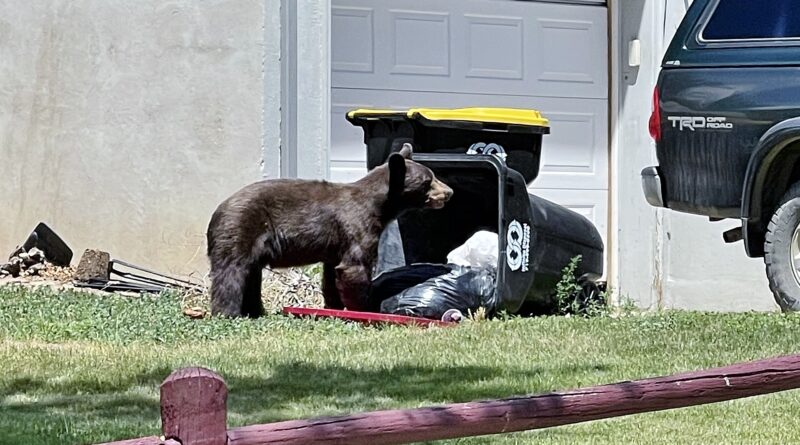
New Colorado law tough on people who feed bears took effect this week
This year is shaping up to be a recordbreaker for bear reports in Colorado.
Colorado Parks and Wildlife has received 6,129 reports of bear sightings and conflicts statewide through Aug. 13 — nearly twice as many as during the same period last year. The number has already surpassed the 5,299 reports CPW received during all of 2025.
The surge reflects a difficult year for Colorado’s bears in the wild.
Low winter snowpack, drought and wildfires have reduced the availability of berries, fruits, nuts, plants and grasses in many parts of the state. And as natural food becomes harder to find, bears are increasingly showing up where people live. Trash, birdseed, pet food, barbecue grills and other human-provided food sources can offer an easy alternative when the natural buffet is sparse.
The problem is likely to become more pronounced in the coming weeks, as bears enter hyperphagia, their annual period of intensive feeding before winter denning. In late summer and fall, black bears may spend up to 20 hours a day searching for food as they build the fat reserves they need to survive the winter.
According to CPW, nearly half of all bear incidents reported in Colorado in 2025 occurred during August, September and October. More than 57% of bear reports were related to trash. About 16% were related to birdseed, pet food, barbeque grills, coolers and refrigerators.
The agency relocated 68 bears because of conflict in 2025 and killed 98.
Wildlife managers are urging residents not to give bears an easy meal — intentionally or accidentally. Bears that repeatedly find food around homes will often return. They can also lose their natural wariness of people, increasing the likelihood of property damage and conflicts with humans. What begins with a tipped-over garbage can can eventually escalate to a bear entering a home.
Now, wildlife officials have another tool for addressing one piece of the problem.
A new state law, House Bill 1342, took effect Wednesday, allowing CPW and other law enforcement officers to ticket people who leave out food or garbage that can attract bears. The law, signed by Gov. Jared Polis earlier this year, changes the standard for luring bears from “intentionally” to “knowingly.” That means law enforcement no longer has to prove that someone intended to attract a bear; it can issue a citation when someone knowingly leaves food or edible waste in circumstances where there is a reasonable probability it will attract one.
The law also removes the requirement that first-time offenders receive a warning. For a third or subsequent offense, the maximum fine increases to $5,000 from $2,000.
But CPW says enforcement is only part of the solution.
The agency is urging Coloradans to secure garbage, recycling and compost cans; remove bird feeders when bears are active; keep pet food indoors; clean and secure grills; and tell neighbors when bears are nearby.
And if a bear starts hanging around a home or repeatedly getting into trash or other attractants, officials say to report it early. Wildlife managers have more nonlethal options when they can intervene before a bear learns that a neighborhood is a reliable source of food. They can help residents identify attractants, haze bears away from homes and, in some cases, trap and relocate an animal.
Once a bear enters a home, however, those options become much more limited.
The goal, especially in a year when natural food is scarce, is to make sure the easiest meal a bear can find is still the one in the forest.